

Are startup directories worth it for SEO?
Last updated 29 October 2026
Guide
A dozen well-chosen listings can give a new site its first links and consistent mentions. Hundreds of bulk submissions add almost nothing.
Startup directories are worth it for SEO only in small doses: a dozen well-chosen listings can give a new site its first crawlable links and consistent brand mentions, while hundreds of bulk submissions add almost nothing and can look like link spam. Treat directories as a one-time foundation task that takes an afternoon, not as a backlink strategy.
The reason is simple. A directory link is easy to get, and links that anyone can get carry little ranking weight. The value is in the few directories that are selective, indexed, and read by your buyers (or by AI tools answering questions about your category).
What a startup directory actually gives you
A startup directory is a website that lists products or companies in a browsable, categorised format, usually with a short description, a logo, and a link to your site. Some are editorial and review submissions. Others accept anything for free.
A listing can produce four different kinds of value. They are not equally likely:
- A crawlable link. Search engines find your site faster when a known site links to it. This is most useful for a brand-new domain with no inbound links.
- Ranking signal. A dofollow link from a relevant, trusted page can contribute. A link from a page buried among thousands of near-identical listings contributes very little.
- Referral traffic. A few directories send real visitors. Most send close to none.
- Entity corroboration. Your name, category, and one-line description appear consistently on third-party pages. This matters for AI answers, because tools like ChatGPT and Perplexity tend to favour claims that several independent sources agree on.
For most startups, the first and fourth are the realistic gains. The second and third are bonuses.
When directories are worth the time
Directories pay off in a specific set of situations.
You have a new domain with zero links
A site with no inbound links is hard for crawlers to discover and easy to ignore. A handful of listings gives search engines a path in and gives you a baseline of third-party references. This is the strongest case for directories, and it is a one-off cost.
The directory sits in your niche
A directory of developer tools linking to a developer tool is a relevant link. A generic "submit your site" page linking to the same tool is not. Relevance matters for Google and matters even more for AI retrieval, where topical fit helps decide which pages get pulled into an answer. Our guide on building backlinks for AI search goes deeper on why link context beats link count.
The directory ranks for "best [category]" queries
This is the most overlooked check. If a directory page appears on Google or gets cited by AI tools when someone searches "best invoicing tools for freelancers," then your listing on that page is effectively a placement in the answer buyers are reading. That is worth far more than a raw link metric.
Buyers actually browse it
Some directories and review platforms have an audience that is shopping. A listing there can bring qualified visitors independent of any SEO effect. You can measure this within a month.
When directories are not worth it
Skip or deprioritise directories in these cases:
- Bulk submission services. Paying for 200 or 500 submissions produces links from pages that nobody reads and search engines barely index. Google's link spam guidance has long treated low-quality directory links among the patterns it considers manipulative, so a pile of them is a risk, not a neutral.
- Directories that are not indexed. If a directory's listing pages do not appear in Google, the link has nothing to pass along.
- Sites that exist only to sell links. If the "free" listing is a gateway to a paid upsell and the pages look templated, the link is unlikely to help.
- Mature sites with real link profiles. If you already earn links from articles, mentions, and communities, another directory listing is a rounding error. Put the hour somewhere else.
A five-minute test for any directory
Before submitting, run this check. It filters out most of the junk.
- Search the directory's name on Google. If it does not rank for its own brand, walk away.
- Search `site:directory.com` plus a keyword from your category. You want to see individual listing pages indexed, not just the homepage.
- Open three random listings. Are they written by humans, differentiated, and current? Or are they thin, duplicated, and full of dead products?
- Check if dofollow or nofollow. Most directories will say if they give dofollow links. If not check the page source for rel="nofollow", rel="sponsored", or rel="ugc". No attribute usually means a normal followed link. Google has treated nofollow as a hint rather than a strict instruction since 2020, so a nofollowed link from a respected site is not worthless. It is just less certain.
For a longer breakdown of criteria such as Domain Rating and audience fit, see our guide to finding free startup directories with dofollow links.
dofollow versus nofollow: how much does it matter?
A dofollow link is a standard link with no attribute telling search engines to discount it. A nofollow link carries rel="nofollow", a signal that the publisher does not vouch for the destination.
Founders often chase dofollow status as if it were the whole game. A nofollow link from a directory that ranks for your category and sends buyers is more useful than a dofollow link from an unindexed page. Ask what the page does for you beyond the attribute.
Directories and AI search
Most directory advice was written for traditional SEO. The picture changes when buyers ask an AI tool for recommendations.
AI answer engines assemble responses from pages they can retrieve and trust. Listicles, comparison pages, and curated directories are common source material for category questions because they already contain structured summaries of many products. If your product is absent from those pages, a competitor that appears on them has the advantage, regardless of how good your own site is.
Two practical consequences follow:
- Consistency matters. Use the same product name, category label, and one-sentence description everywhere. Mismatched descriptions weaken the corroboration that makes an AI tool confident enough to name you.
- Your own page must back the listing up. A directory entry that points to a site AI crawlers cannot read does nothing. Check your robots.txt and firewall settings first. Our free robots.txt tester shows whether the main AI crawlers can reach a page.
To see which directories matter in your category, ask ChatGPT, Perplexity, and Google a few "best [category] for [audience]" questions and note which directory or list pages appear in the sources. Those are your priority targets. This is an observation you can verify yourself in ten minutes, and it beats any generic top-100 list. If you are new to the idea of structuring pages so they can be quoted directly, what is AEO covers the fundamentals.
A realistic plan for one afternoon
You do not need more than a few hours.
- Step 1: Prepare your listing assets (30 minutes). Write one 25-word description, one 60-word description, a category label, a logo, and two screenshots. Reuse them everywhere.
- Step 2: Build a shortlist of 10 to 15 (45 minutes). Mix three types: a few well-known startup launch sites, two or three directories specific to your niche, and any review platform your buyers use. Cut anything that fails the five-minute test.
- Step 3: Submit and record (60 to 90 minutes). Keep a spreadsheet with the directory, submission date, link attribute, and listing URL.
- Step 4: Check after 30 days. For each listing, record whether it is indexed, whether it sends any visits (check referrals in your analytics), and whether it shows up in AI answers.
- Step 5: Stop. Directory returns flatten quickly. After the first batch, spend your time on content, Reddit conversations, and relevant mentions on other sites, where the compounding happens.
Where Geograph's directory launch tool fits
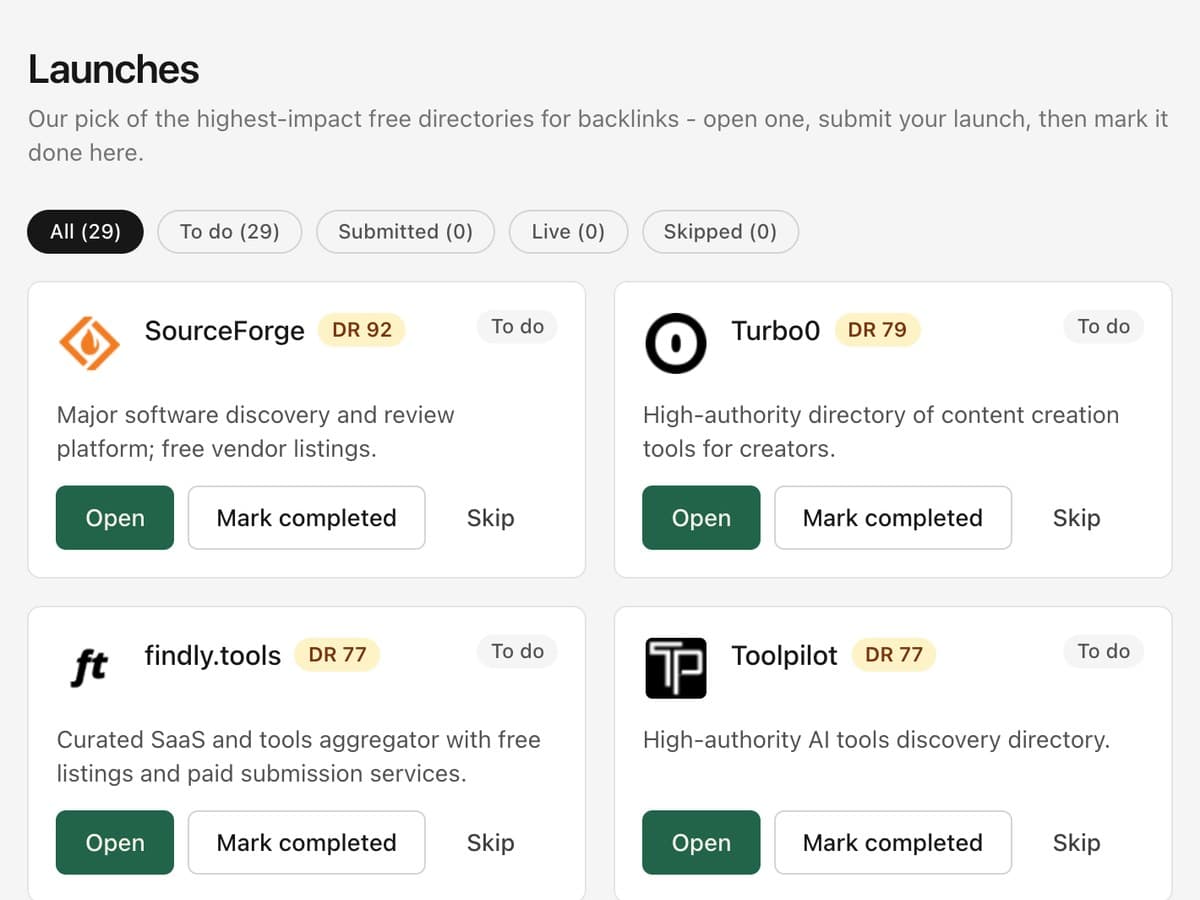
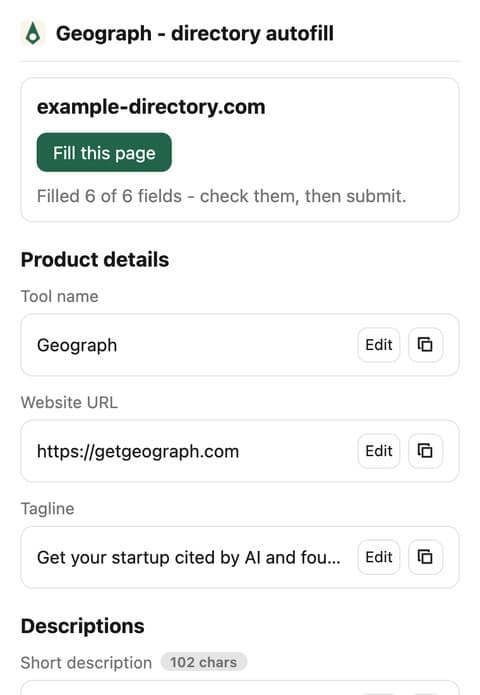
Step 3 is the slow part of the plan. The work itself is not hard, but it means typing the same product name, description, category, and URL into a dozen different forms. Geograph includes a directory submission and form-filling tool built for that step, plus a shortlist of our recommendations for the best directories worth your time.
Finalise your descriptions before you start, since every listing will inherit them. Keep them consistent with your website copy.
What directories cannot do
Directories will not fix a site that is slow to load, hard to crawl, or thin on useful content. They will not make you rank for competitive terms by themselves, and they will not replace the contextual links that come from being discussed or cited inside real articles. Popular platforms like Product Hunt and G2 are good for visibility and credibility, but their links often carry limited ranking value, so judge them on audience rather than on link metrics.
The pattern that works is layered: a small base of directory listings, then contextual links from relevant sites, then active participation in the communities where your buyers ask questions.
The takeaway
Give directories one afternoon and a hard cap of fifteen listings, then judge them by data: indexed or not, referrals or not, appearing in AI answers or not. Keep the ones that pass and drop the rest. If you would rather not fill in fifteen submission forms by hand, Geograph includes a directory submission and form-filling tool, plus a backlink network that places contextual links only where a relevant one exists, which is the step that tends to matter after the directory base is in place.
Frequently asked questions
- Are free startup directories worth it?
- Some are. Free directories that are indexed, selective, and relevant to your category are worth an hour of effort each. Free directories that accept anything and are not indexed are not. Price is a poor signal in either direction.
- How many directories should a startup submit to?
- Ten to fifteen vetted ones is enough for most startups. Past that point, each additional listing adds less and the risk of low-quality links grows.
- Do directory backlinks help with Google rankings?
- A few can, mainly for new domains that need discovery and a first set of references. They rarely drive rankings for competitive terms on their own.
- Can directory listings help me get cited by ChatGPT or Perplexity?
- They can help indirectly. Directories and list pages are frequent sources for category questions, and consistent descriptions across several independent pages make your product easier for AI tools to name. They work best alongside a crawlable site and clear, quotable content.
- Is paying for directory submissions a good idea?
- Rarely. Paid bulk packages mostly produce links on pages nobody reads. If you pay for anything, pay for a specific listing on a platform your buyers actually use.
- Can directories hurt my SEO?
- A small number of reputable listings will not. Large volumes of low-quality directory links can resemble link manipulation, which Google's spam policies target. Quality control is the protection.
Start getting found on AI, Google and Reddit
- 15 articles a month optimised for AI & search citation
- Get backlinks on autopilot from other members
- Real time Reddit monitoring with reply drafts to drive traffic and AI mentions
- Weekly deep site audits with a full report card, tracked over time
- All built to maximise AI mentions and search ranking
Pricing and figures mentioned are accurate as of publish (29 October 2026) and may have changed since - check each provider's site for current numbers.

Written by Toby Marshman