
How to find the best free startup directories for backlinks
Last updated 25 October 2026
Guide
How to find directories that are free and still give a dofollow link, why Product Hunt and G2 are for traffic rather than backlinks, and how to submit fast.
If you are listing your startup for backlinks, look for directories that are free, give you a dofollow link, and have a real audience and a decent Domain Rating (DR). Below is how to find and vet them yourself - and, if you'd rather skip the research, Geograph gives you our selection of the 30 highest-DR free dofollow directories we have found, with a Chrome extension that fills in each listing for you.
The famous names are a different job. Product Hunt, G2 and Capterra are worth a listing for traffic and credibility, but for backlinks they disappoint: their links are usually nofollow or sit behind paid placement, a launch brings a spike that fades within days, and ranking near the top of Product Hunt is hard without a big prepared audience.
Directory links also do more than move DR. They create independent pages describing your product that Google and AI engines can cross-check, which is a large part of how a young product starts to look real to them.
What DA and DR measure (and what they don't)
Domain Authority (DA) is Moz's 1 to 100 score predicting how likely a site is to rank, based largely on its backlink profile. Domain Rating (DR) is Ahrefs' equivalent: the strength of a site's backlink profile on a 0 to 100 logarithmic scale, based on the number and strength of unique referring domains.
Neither is a Google ranking factor - Google has said it does not use third-party authority scores. They are a rough scoreboard, and a quick way to size up a link source.
Directories suit that scoreboard because they are easy to get and many have a high DR. That is also why they are overrated: a high-DR directory may put your link on a page with hundreds of other outbound links. When your profile is small, a handful of unique referring domains moves DR visibly. After that, each extra directory adds less.
How to find startup directories worth submitting to
Start with the search engines themselves. Searches like "submit your startup", "submit your SaaS" free, "launch directory" dofollow and "submit AI tool" turn up hundreds of candidates. So do the "as seen on" badges in the footers of indie products in your category - they show you where similar founders listed.
Then vet each one before you spend time on its form:
- Free to list: no payment needed for the listing itself. Many sell optional upgrades - you don't need them.
- Dofollow link: open the page source of an existing listing and check the link to the product has no rel="nofollow" or rel="sponsored". Some directories only switch dofollow on once their badge is on your site.
- Domain Rating: check it in Ahrefs' free website authority checker. Higher is better, but only alongside the other checks.
- Real audience: do buyers or builders actually browse it, or only other submitters?
- Editorial filter: does it review submissions? Directories that accept everything carry little trust.
- Link attribute: followed, nofollow or sponsored? Nofollow listings can still send readers, but don't count them toward authority.
- Indexing: a few weeks after submitting, search site:directory.com "your product". If the listing isn't indexed, it isn't doing much.
- Category fit: a listing next to your direct competitors beats a generic "startups" page.
Skip any directory that sells bulk submissions to hundreds of sites, requires a reciprocal link to a page full of unrelated links, or has a footer of casinos and loans. Expect to discard most of what you find.
Geograph's directory submission tool
Finding and vetting directories takes days; submitting to them takes longer, because every form asks for the same details in a different shape. Geograph does both parts for you.
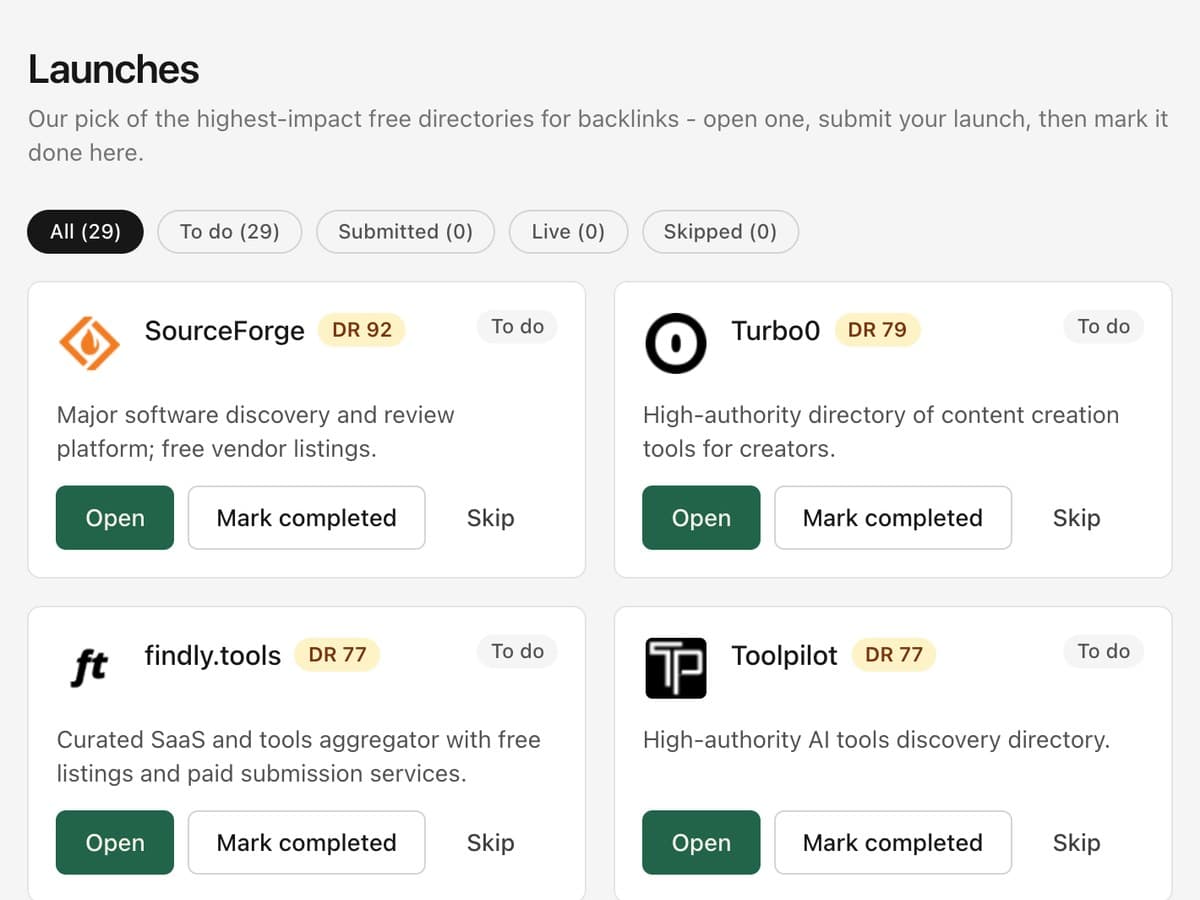
- Our selection of 30 directories: the 30 highest-DR free directories with a dofollow link we have found, from SourceForge (DR 92) down, each with its DR and what it asks for. If one starts charging or drops its dofollow link, you can report it from its tile.
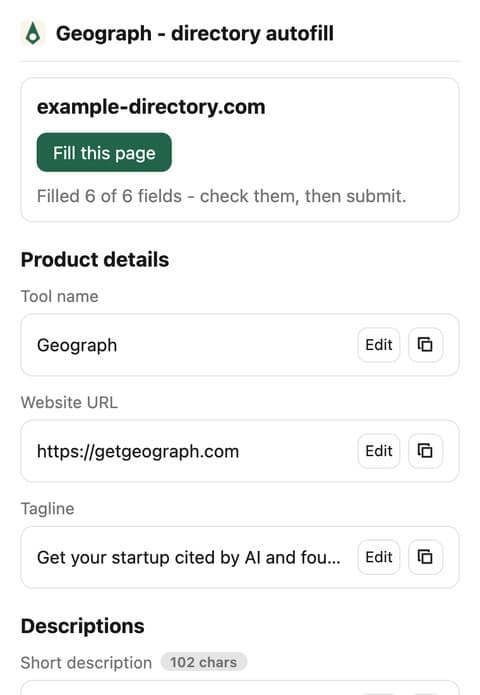
- A Chrome extension that fills the forms: save your product details once, open a directory, and the Geograph extension fills its listing form from your profile. You always press submit yourself.
- The Launches tab: tracks which directories you have submitted to, completed or skipped.
It is included in every Geograph plan, alongside Reddit monitoring, articles and the weekly audit.
What about Product Hunt, G2, Capterra and BetaList?
They are the names everyone knows, and none of them is in our selection. Not because they are bad, but because they do a different job.
- Product Hunt: the listing link is nofollow, so it does little for DR. A launch can bring a burst of traffic and the odd newsletter mention, but it spikes and fades within days, and reaching the top of the day usually takes a prepared audience of supporters, which most first-time founders do not have. Launch there for exposure, not for the link.
- G2 and Capterra: free profiles, but the value is in reviews, and the traffic-sending placements are paid. A profile with no reviews is nearly invisible. Worth it once you have customers who will review you.
- BetaList: editor-reviewed and good for pre-launch products, but the free queue can take weeks.
A useful rule: a directory that charges for the listing, or gives you only a nofollow link, should earn its place through traffic you can measure. If it cannot, skip it.
A suggested order of operations
- Write one description pack. A 160-character tagline, a 50-word and a 150-word description, three screenshots and a logo. The same wording everywhere strengthens the signal.
- Set up your entity profiles. Crunchbase and a LinkedIn company page are not backlink plays, but they confirm your company exists with the same name, description and URL.
- Submit in batches. Five or six a sitting is manageable, or more with the extension filling the forms.
- Add the badges you need. For directories that only switch on dofollow with their badge, add it to your footer.
- Check indexing at four weeks. Fix or drop listings that aren't indexed.
What to expect
For a new SaaS with a near-empty backlink profile: a small but visible DR increase, a few referral visits a week, and listings that start showing up for your brand name. Not rankings for competitive keywords - directories alone won't do that.
Where they do pay off is brand search and AI corroboration. When an engine sees the same description, category and URL on several independent sites, it has more reason to treat your product as real and recommendable.
Mistakes that waste the most time
- Paying for the famous names first: a paid or nofollow listing with no measurable traffic is the worst of both.
- Submitting to hundreds of directories: past a few dozen good ones you add maintenance and risk, not value.
- Inconsistent descriptions: different names, taglines and categories weaken the entity signal.
- Stopping at directories: a link inside a relevant article, where the text explains why your product matters, carries context a directory row can't.
The takeaway
Find directories that are free, dofollow, indexed and relevant - or start from Geograph's selection of 30 and let the extension fill the forms. Add the badges they ask for and check indexing after four weeks. List on Product Hunt or G2 when you have a launch audience or reviewers lined up - for traffic, not links.
Then put the saved hours into contextual links: a mention in a relevant article, a helpful answer in the Reddit thread where buyers ask for recommendations. Geograph covers that next layer with Reddit monitoring and a vetted backlink network, and the guide to getting high quality backlinks walks through the rest.
Frequently asked questions
- Do directory backlinks still help SEO?
- They help most when the directory is real, indexed and relevant to your category, and most for young sites with few referring domains. Bulk submissions to low-quality sites add nothing.
- Is a Product Hunt launch good for backlinks?
- Not really. The listing link is nofollow, and launch-day traffic spikes and fades. It can be worth doing for exposure and any press or newsletter mentions that follow, but not as a link-building step.
- Are nofollow directory links worth it?
- For traffic and brand corroboration, sometimes. They count for less with authority metrics, so judge them on the referral traffic they actually send.
- Should I pay for directory listings?
- Rarely. Pay only if the directory has a measurable audience of buyers in your category and you can track conversions. Never pay for a service that promises hundreds of links.
- How long until directory links show up?
- Usually a few weeks, sometimes longer: a link only counts once the directory page has been crawled. Ahrefs, Moz and Semrush each run their own crawler, so a link can appear in one tool before another. Watch the referring domains report in whichever you use, since the headline DR or DA score moves more slowly. Geograph records your Moz DA every four weeks in the weekly audit.
Start getting found on AI, Google and Reddit
- 15 articles a month optimised for AI & search citation
- Get backlinks on autopilot from other members
- Real time Reddit monitoring with reply drafts to drive traffic and AI mentions
- Weekly deep site audits with a full report card, tracked over time
- All built to maximise AI mentions and search ranking
Pricing and figures mentioned are accurate as of publish (25 October 2026) and may have changed since - check each provider's site for current numbers.

Written by Toby Marshman